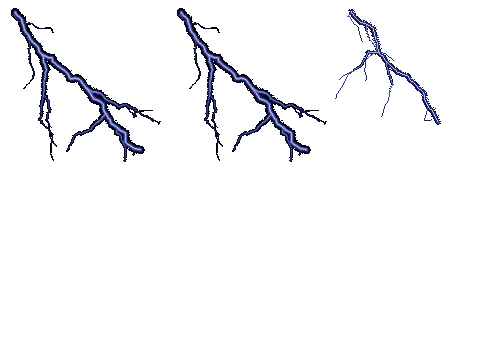
Corked lightning: Crooked or branched channels in a
lightning stroke. Observers might see these ominous-looking
bolts shoot from the cloud to the ground, from one cloud
to another, or out of the top or sides of a storm. Cloud-to-cloud
lightning is the most common, while only about 20 percent
of all discharges are cloud-to-ground. Less common are
bolts that shoot from cloud-to-air. Occasionally these
strike up to 10 miles away from a thunderstorm. If the
sky overhead is clear when the renegade lightning strikes,
these "bolts from the blue" will seem to appear
out of nowhere. Sheet lightning: Stroke appears within a
cloud or is obscured by nearby clouds. Flashes of
lightning can illuminate entire clouds, making them
visible from miles away. With sheet lightning, the
observer is near enough to hear the thunder. Those
farther away might report "heat lightning."
Heat lightning: Flashes too far away for observer to hear
the thunder. Like sheet lightning, these flashes are
created by lightning bolts, but are in thunderstorms more
than 10 miles away. Trees, buildings and urban noise can
cut this distance to less than five miles. It's called
heat lightning because it is seen more frequently on hot
summer nights when the sky overhead is clear. Often, air
molecules and dust particles in the atmosphere refract
the light coming from distant lightning, making the bolts
or flashes appear orange.
Ball lightning: Extremely rare, nearly phantom, luminous
spheres. Less than three feet wide, these glowing balls
have been seen coming from some of the more violent
thunderstorms, which contain lots of lightning. In nearly
all reported cases, the observers saw another form of
lightning flash before seeing ball lightning. Lasting
from several seconds to several minutes, the spheres can
simply vanish after traveling slowly toward the ground.
Usually no damage is left behind by ball lightning, but
at times they have traveled through windows and screens,
leaving behind burn marks. Reports of ball lightning have
come from passengers on planes as well as from poeple in
their homes or on ships. Still, some scientists don't
believe ball lightning exists.
St. Elmo's Fire: Luminous greenish or bluish glow above
pointed objects on the ground. Named for the patron saint
of sailors, St. Elmo's Fire is created by the soft glow
of an electric field generated by a continuous flow of
tiny sparks. The tiny sparks are postive charge reaching
skyward in response to a growing area of negative charge
in the clouds or air above.Instead of generating a
lightning strike, the corona discharge, as it's called,
flees objects such the masts of ships, power poles,
antennas, and the wings of aircraft, causing the glow. If
a thunderstorm is nearby, St. Elmo's Fire might precede a
lightning strike close.
High-altitude lightning: Recently-discovered colored
flashes of light high above thunderstorms. Playful names
such as "red sprites," "blue jets,"
and "green elves" have been given to these
distincly different forms of lightning. They shoot up
from the tops of thunderstorms about the same moment
lightning discharges within the storm cloud. Occurring in
the middle of the atmosphere, red sprites look like the
stems of carrots, while blue jets are small streaks of
light with flared ends like the horn of trumpet. Green
elves are nearly-invisible, glowing, jellyfish-shaped
amoebas that spread across the upper atmosphere.